
30-Second Read — Is this for you?
In one line. A side-by-side look at financing vs paying cash — capital deployment, yield-on-equity, liquidity, and total cost of ownership — using current 2026 market figures.
Best for. Buyers and investors active in or considering the Dubai property market.
What you will learn.
• Non-resident LTV caps sit at 50% for off-plan and up to 60% for ready property — which changes the down-payment maths considerably against comparable resident terms.
• Fixed mortgage rates for foreign buyers opened 2026 in the 3.99%–4.2% range (1–3 year initial period) before reverting to EIBOR-linked variable rates; the broader band runs 4.8%–6.2% depending on profile and product.
• Gross rental yields across Dubai range from around 4% for large villas to over 8% for well-positioned studios and small apartments — a spread that directly shapes the financing case.
Bottom line. When gross yield clearly clears the borrowing rate, financing can produce positive carry. When the margin is thin, the case weakens and the simplicity of a clean cash purchase becomes more compelling.
 Noor Al Nahyan
Introduction
Dubai's property market recorded AED 138.7 billion worth of deals across 44,150 transactions in Q1 2026 alone — up 21.2% by value year-on-year (Property Finder, Q1 2026). Inside that volume, cash buyers still account for the dominant share: Knight Frank estimated cash sales at approximately 86% of total transaction volume in Q1–Q3 2025, and February 2026 secondary-market data showed around 69% of resale deals settling in cash (Edwards & Towers / DLD data, February 2026). Yet mortgage-backed transactions grew 23% year-on-year as of Q4 2025 (Astra Terra Properties, citing DLD Q4 2025 data), signalling that a growing cohort is actively running the numbers on the financing trade-off.
Paying cash removes the mortgage registration fee, bank arrangement fee, and third-party valuation cost. That single fact shifts the total-cost-of-ownership comparison meaningfully. Each option below is described on its own terms, then the trade-offs are laid out side by side.
Where opinion appears below, it is labelled. Where the data has limits, those limits are stated alongside the figure. Sources sit at the end so anything contested can be checked directly.
What the Data Actually Says
Where this fits in the broader picture.
Here is the honest side-by-side. As of Q1 2026, fixed mortgage rates for foreign buyers open in the 3.99%–4.2% range for 1–3 year initial periods before moving to EIBOR-linked variable pricing; the overall rate band runs 4.8%–6.2% depending on the buyer's profile, lender, and product type (Westgate Dubai / Mortgease, April 2026). The three-month EIBOR — the benchmark underpinning most UAE variable-rate mortgages — was running at approximately 4.5%–5.0% as of April 2026, with the UAE Central Bank tracking US Federal Reserve settings closely given the AED/USD peg (Mortgease, April 2026). Analysts expect EIBOR to remain in a broadly stable corridor through 2026, with any cuts gradual rather than sharp (Gulf News, January 2026).
Against those borrowing costs, gross rental yields across Dubai range from around 4% for large villas to over 8% for well-positioned studios and small apartments, with investor-friendly mid-market areas such as Jumeirah Village Circle sitting in the 6.78%–7.87% band (GuestReady, 2026; Sands of Wealth, early 2026). The average net yield — after service charges, vacancy, and management — sits at approximately 4.6% across all property types (Sands of Wealth, early 2026).
When gross yield visibly clears the financing rate with margin to spare, a mortgage produces positive carry; when the spread is thin, it does not — and the argument for cash strengthens.
Both options can be the right answer depending on the buyer's position. The wrong answer is choosing without first being clear on what the asset actually needs to do.
Mortgage vs Cash — Side by Side (June 2026)
| Dimension | Mortgage | Cash |
|---|---|---|
| Capital deployed | Down payment only: min. 40%–50% for non-residents (off-plan 50% LTV cap; ready property 60% LTV cap) — CBUAE rules, 2026 | Full purchase price |
| Upfront cost add-on | 4% DLD transfer fee + 0.25% mortgage registration fee (+ AED 290) + bank arrangement fee (0.5%–1% of loan) + valuation (AED 2,500–3,500). Total closing costs typically 6%–9% of purchase price (Sands of Wealth, 2026) | 4% DLD transfer fee + trustee and registration fees (~AED 2,000–4,000 + VAT). Minimum-scenario total typically 2.5%–5% of purchase price (Sands of Wealth, 2026) |
| Financing rate (non-resident, 2026) | 3.99%–4.2% fixed (1–3 yr initial); 4.8%–6.2% overall range; variable = 3-month EIBOR (~4.5–5.0%, April 2026) + bank margin 1.75%–3.25% (Westgate Dubai / Mortgease, April 2026) | No financing cost; opportunity cost depends on alternative use of capital |
| Yield on equity | Amplified when gross yield exceeds borrowing rate. Gross yields: 6.78%–7.87% in JVC; up to 8%+ for studios in strong-demand areas (GuestReady, 2026). Net avg ~4.6% citywide (Sands of Wealth, 2026) | Equals gross yield on purchase price — typically 4% (large villas) to 8%+ (small apartments), early 2026 |
| Liquidity | Residual equity preserved for redeployment or diversification across multiple assets | Full capital tied to one asset; no recurring debt obligation |
| Market context (2026) | Mortgage-backed transactions +23% YoY (DLD Q4 2025); ~25% of total sales value in 2025 (AGBI, January 2026) | ~86% of Dubai transaction volume (Q1–Q3 2025, Knight Frank); ~69% of secondary-market resales (February 2026, Edwards & Towers / DLD) |
| Best suited to | Diversifying across two or more assets; buyers with verifiable income who clear the CBUAE Debt Burden Ratio cap of 50% of gross monthly income | Simplicity, no rate risk, faster closing; buyers with concentrated capital who prefer no debt obligation |
The Honest Risk Picture
Three risks worth flagging up front.
- Rate quoted is not rate paid. Most non-resident quotes exclude the bank arrangement fee (0.5%–1% of the loan) and third-party valuation (AED 2,500–3,500). Together these move the effective first-year rate up by roughly 0.3–0.6%. Factor them in before comparing against net yield (Mortgage Finder / Kingsbury & Partners, 2025–2026).
- Cash buyers face FX and timing risk too. A buyer converting GBP, EUR, or INR into AED faces exchange-rate exposure on a transaction that may take weeks to complete. A material currency move on a large sum can erode the cost advantage a cash purchase appeared to carry.
- Mortgage debt is not portable. If you need to sell quickly, mortgage discharge adds process time and friction the cash buyer avoids. Separately, since early 2025, the UAE Central Bank directed banks to stop financing DLD registration fees and broker commissions — those costs must now come from the buyer's own funds regardless of whether a mortgage is used (AGBI, January 2026).
"Financing is not free money and it is not a trap — it is a spread trade. If the gross yield clears the borrowing rate with margin to spare, it works. If it does not, cash is the honest answer."
— YAZDAN Research
Want this read tailored to your own position?
30 minutes with our advisory team — no pitch, no commission talk.
How to Use This in a 2026 Plan
Where this fits in the 2026 plan.
- Calculate yield on equity, not yield on price. With a 40% down payment on a non-resident mortgage, the same rental income is being measured against 40% of the property's value rather than 100%. That amplifies the return on deployed capital — but only while the gross yield exceeds the borrowing rate. At current market figures (gross yields 4%–8%+, fixed rates from 3.99%), the spread is positive for mid-market apartments in high-demand locations and thin-to-negative for prime villas where gross yields sit closer to 4%–5%.
- Stress-test the deal at rates 2% above today's. With 3-month EIBOR at approximately 4.5%–5.0% (April 2026) and UAE rate direction tied to the US Federal Reserve — where analysts see limited near-term cut probability (Arabian Business, 2026) — a 2% upward stress remains a plausible planning scenario for variable-rate holders. If the deal still clears at that level, genuine buffer exists. If not, today's rate is the load-bearing assumption.
- Match the product to the hold period. A 1–3 year fixed rate (starting from 3.99% for eligible profiles) gives predictability during the initial hold window. Buyers intending to exit within that window should account for early-repayment charges — typically 1% of the outstanding balance, capped at AED 10,000 (Mortgage Finder, 2025).
Catalysts to Watch
What would change the picture from here.
- Fed rate path and EIBOR direction. The AED is pegged to the USD, so UAE mortgage rates move with the US Federal Reserve. Gulf News (January 2026) noted that UAE borrowers should expect rate moves to be gradual rather than sharp; even a 0.5% shift in the 3-month EIBOR meaningfully changes the cash-vs-finance break-even for variable-rate holders. The Fed's June and September 2026 meetings are the next substantive data points to watch.
- LTV cap changes. Current CBUAE rules cap non-residents at 50% LTV for off-plan and 60% for ready property. Any regulatory adjustment — upward or downward — directly alters the capital required to enter on finance. The Central Bank's direction to stop banks from financing DLD fees and broker commissions (from early 2025) signals a broadly cautious regulatory posture toward debt-financed acquisition costs.
- Rental yield compression from new supply. Dubai has approximately 120,000 units scheduled for handover in 2026, the largest pipeline in recent history (Driven Properties, 2026). If this supply absorbs cleanly, yields hold. If vacancy ticks up, net yields — already averaging around 4.6% across all asset types — could compress further, narrowing the positive spread over financing rates.
- Price growth moderating. Knight Frank's baseline for 2026 is approximately 3% growth in the prime segment and around 1% in the mainstream market (Global Property Guide / Knight Frank, 2026). In a lower-appreciation environment, the capital-gain component of total return shrinks, placing more weight on the rental yield as the primary justification for a financed purchase — which brings the spread calculation back to centre.
Frequently Asked Questions
Is it better to buy Dubai property in cash or with a mortgage?
It depends on your goal and position. Cash removes rate risk and simplifies closing — approximately 86% of Dubai transaction volume in Q1–Q3 2025 settled in cash (Knight Frank). A mortgage lets you spread capital across more than one asset and amplify yield on equity when the gross rental yield exceeds the borrowing rate. For well-located mid-market apartments, gross yields of 6.78%–7.87% in areas like JVC (GuestReady, 2026) sit above the 3.99%–4.2% fixed-rate floor for eligible buyers, though net yield (avg ~4.6%) and effective rate after fees narrow that spread considerably.
Can foreign buyers get a Dubai mortgage?
Yes. A number of UAE banks lend to non-residents. Under current UAE Central Bank rules (2026), non-residents are capped at 50% LTV for off-plan purchases and up to 60% LTV for ready property — meaning a minimum down payment of 40%–50% is required. Lenders also apply a Debt Burden Ratio ceiling of 50% of gross monthly income across all existing commitments. Not all UAE banks offer non-resident products; a licensed mortgage broker can identify which lenders are currently active in this segment.
What extra costs come with a mortgage?
The DLD mortgage registration fee is 0.25% of the loan amount plus AED 290. Banks typically charge an arrangement fee of 0.5%–1% of the loan and require a third-party valuation costing AED 2,500–3,500. Combined with the standard 4% DLD transfer fee, total closing costs for a mortgage buyer typically run 6%–9% of the purchase price (Sands of Wealth, 2026). A cash buyer avoids the registration, arrangement, and valuation costs. Importantly, since early 2025, UAE banks have been directed to stop financing DLD fees and broker commissions — those costs must come from the buyer's own funds in either case (AGBI, January 2026).
Does financing make sense at current rates?
When the asset's gross yield clearly exceeds the mortgage rate, financing can produce positive carry. With fixed rates starting from 3.99% for eligible profiles and gross yields on well-located apartments running 6.78%–7.87% in areas like JVC (GuestReady, 2026), the headline spread looks positive in those locations. But the effective rate — once arrangement fees and valuation are built in — moves up by roughly 0.3–0.6%, and net yield (approximately 4.6% across all property types, Sands of Wealth 2026) is what matters for actual cash flow. When that gap is thin, the case for financing weakens and rate risk matters more.
What is yield on equity?
Yield on equity is the annual rental return measured against the cash you actually put in, not the property's full price. If a buyer puts 40% down on a non-resident mortgage, rental income is divided by that 40% — amplifying the stated return compared with a full cash purchase. The amplification works in the buyer's favour while the gross yield exceeds the borrowing rate; it works against the buyer if that spread turns negative — for example, if rents compress while variable rates remain elevated.
Conclusion
Non-resident buyers in Dubai face a 40%–50% minimum down payment (50% LTV cap for off-plan; 60% for ready property), fixed introductory rates from 3.99% rising to a 4.8%–6.2% overall range, and total mortgage-scenario closing costs of 6%–9% of the purchase price.
Against that, gross rental yields range from around 4% for large villas to over 8% for small apartments in strong-demand locations — a wide spread that makes the right answer highly asset-specific. The right way to use this comparison is to start with the buyer's constraints — capital available, income profile, hold period, and risk tolerance — and map the numbers against those constraints. Starting with the options and trying to make the constraints fit is where most regret originates.
 Noor Al Nahyan
Related YAZDAN insights
Sources
- Dubai Mortgage for Expats 2026: Rates, LTV, Best Banks — Astra Terra Properties (citing DLD Q4 2025 data; accessed June 2026)
- Non-Resident Mortgages Dubai 2026: LTV Ratios & Rates — Westgate Dubai (April 2026)
- UAE Mortgage Rates Today: Compare All Banks — Mortgease (April 2026)
- Dubai's property boom leans on cash as mortgage lending lags — AGBI (January 2026)
- UAE borrowers brace for slower rate cuts in 2026 — Gulf News (January 2026)
- UAE borrowers face long wait for cheaper credit — Arabian Business (2026)
- Dubai Real Estate Hits Overdrive: Cash Buyers and Primary Sales Dominate 2026 — Edwards & Towers (February 2026)
- UAE Residential Property Market Analysis 2026 (incl. Knight Frank citation) — Global Property Guide (2026)
- Dubai Property Market Breaks Records in Q1 2026 — Olives Homes (citing Property Finder Q1 2026 data)
- Best Rental Yields in Dubai 2026 — GuestReady (2026)
- Dubai Latest Rental Yields Data (2026) — Sands of Wealth (early 2026)
- Property Taxes, Fees and Costs in Dubai (2026) — Sands of Wealth (early 2026)
- Dubai Real Estate Transactions — Driven Properties (citing DLD data, 2026)
- Dubai Property Fees Explained — Mortgage Finder (2025)
- UAE Mortgages for Expats: Deposit Requirements, Rates & Property Finance Explained — Kingsbury & Partners (2025–2026)
Want a tailored read for your own position?
YAZDAN Properties is a Dubai-based real-estate advisory firm. We work with international and UAE-based investors on neutral, data-led reviews — no pressure, no commission talk, just a clear look at the numbers.
Book a 30-minute advisory call →Or email info@yazdan.ae directly.
This article is editorial analysis and does not constitute investment advice. All figures cited are sourced and dated; market data may have moved since publication.
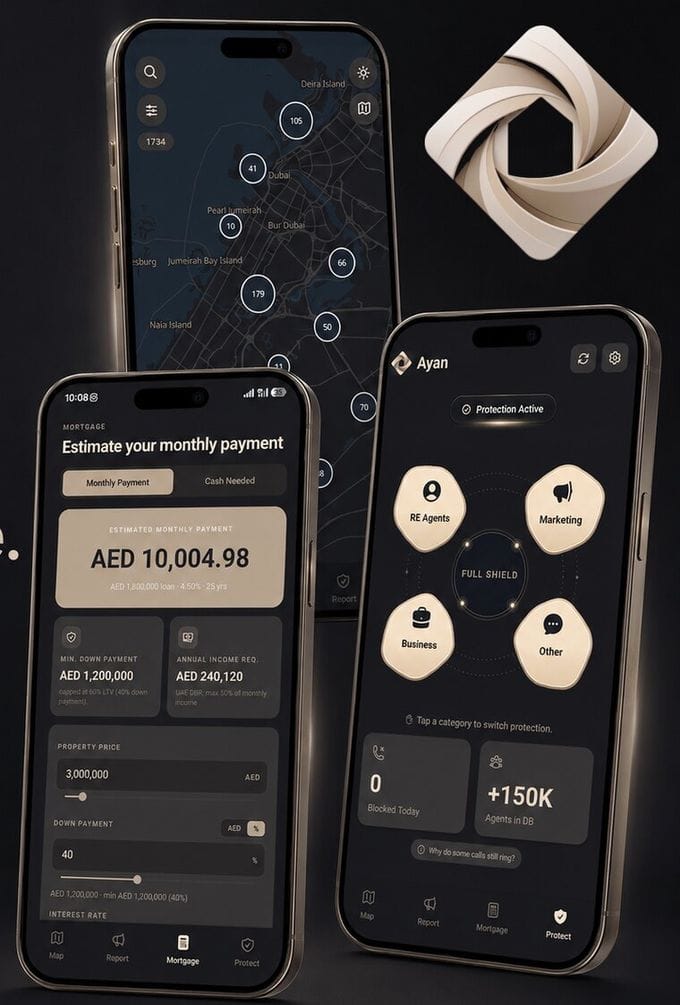
A live off-plan map of 1,700+ UAE projects, a full UAE mortgage calculator and OS-level spam-call protection, all in one app.
Get the AYAN app →Or go straight to the App Store or Google Play. On a computer? Open map.YAZDAN in your browser, no download needed.
YAZDAN Properties reads the DLD numbers for your goal, whether you're buying, selling or investing, and tells you plainly what they mean for you.
Book a 30-minute advisory call → WhatsApp usOr email info@yazdan.ae directly.