Last checked 26 October 2026 against official sources · Dubai Property Law series · General information, not legal advice
Under Dubai Law No. 8 of 2007, a developer selling off-plan must be registered with the Dubai Land Department and open a separate escrow account for each project with an accredited bank. Buyers' payments go into that account, can only be used to build that project, and can't be seized by the developer's creditors. The law controls how your money is used. It doesn't guarantee the project will be finished on time.
Best for. Anyone buying off-plan in Dubai, from a developer or as a resale.
What you'll learn.
- What the escrow law requires of developers
- What happens to the money after completion
- Where the law's protection stops
- Your position if you miss payments or the project stalls
- A checklist before you pay
Bottom line. Pay only into the project's escrow account, check the project is registered with DLD, and register your unit on Oqood.
What the law requires
| Article | Rule |
|---|---|
| 4 | Developers must be entered in DLD's Register of Real Estate Developers and licensed to operate. |
| 5 | Developers need DLD's written approval before they advertise or exhibit off-plan units. |
| 6 | A developer that wants to sell off-plan must apply to DLD to open an escrow account, with the land title deed, approved designs, a certified cost and revenue statement and a standard sale contract, among other documents. |
| 7 | The account is opened with an accredited escrow agent, which is a bank. Payments from buyers and project financiers go into it. |
| 9 | Each project has its own account. The money is reserved for building that project and can't be attached by the developer's creditors. |
| 12 | Depositors can see and copy their own records. |
| 13 | If a developer borrows against the project, the lender pays the loan into the escrow account. |
| 14 | After the completion certificate, the bank keeps back 5% of the account and releases it one year after the units are registered in buyers' names. |
| 15 | If a project stops in an emergency, the escrow agent, after consulting DLD, must protect buyers by getting the project completed or refunding payments. |
| 16 | Unlicensed development, false documents, selling units in fraudulent projects or misusing project money can mean prison, a fine of at least AED 100,000, or both. |
| 17 | DLD can strike off a developer that hasn't started building six months after getting permission to sell off-plan, among other grounds. |
Source: Law No. 8 of 2007 Concerning Escrow Accounts for Real Estate Development in the Emirate of Dubai.
Where the protection stops
- It covers money paid to the developer. If you buy an off-plan unit from another buyer, the premium you pay them on top of the developer's price goes to the seller, not into escrow.
- It doesn't guarantee completion or a handover date. Delays are dealt with under your sale agreement and the Interim Register law, Law No. 13 of 2008.
- It doesn't give buyers a direct right to cancel. Cancellation rights come from Law No. 13 of 2008, as amended (most recently by Law No. 19 of 2020), and from your contract.
- Money paid outside the escrow account is exposed. Cash, or a transfer to a developer's ordinary account, is much harder to trace and recover.
If a project is cancelled or stalls
If RERA cancels a project by a reasoned decision, the developer must refund everything buyers have paid, in line with Law No. 8 of 2007 (Article 11(b) of Law No. 13 of 2008, as amended). If a project stops in an emergency, Article 15 of the escrow law requires the escrow agent, after consulting DLD, to protect buyers by getting the project finished or by refunding them.
If you miss off-plan payments
A developer can't simply keep your money. Under Article 11 of Law No. 13 of 2008, as amended in 2017 and again in 2020, the developer must report the breach to DLD, which gives you 30 days' written notice to pay and may try to settle the matter. If you still don't pay, DLD certifies how far the whole project has progressed (since the 2020 amendment it's the project's completion that counts, not your unit's), and that decides what the developer can do:
| Project progress | Developer's options | What the developer can keep if it cancels |
|---|---|---|
| Over 80% | Keep the contract and claim the balance, ask DLD to auction the unit, or cancel | Up to 40% of the unit price |
| 60% to 80% | Cancel | Up to 40% of the unit price |
| Under 60%, work started | Cancel | Up to 25% of the unit price |
| Work not started | Cancel | Nothing: everything you paid must be refunded |
Source: Article 11 of Law No. 13 of 2008, as amended by Law No. 19 of 2017 and Law No. 19 of 2020.
Anything above those amounts must be refunded within a year of cancellation or within 60 days of the unit being resold, whichever comes first. Before 2020 a developer could keep up to 30% even when work hadn't started; Law No. 19 of 2020 removed that, so a developer that hasn't started building must return everything it received. Buyers can still go to court or arbitration if a developer abuses these powers.
Checklist before you pay
- Check the developer and the project on DLD's records, for example in the Dubai REST app, and confirm the project is registered for off-plan sales.
- Check that the escrow bank and account number in your sale agreement belong to that project.
- Pay only into that escrow account, quoting the reference the developer gives you. Don't pay cash or into any other account.
- Register your purchase in the Interim Register (Oqood). The DLD fee is 4% of the price, and registration records the unit against your name before handover.
- Follow construction progress through DLD's services and keep every receipt.
- Read the delay, cancellation and handover clauses in the sale agreement before you sign.
Common questions
Is my off-plan payment safe in escrow?
Safer, not risk-free. Escrow money can only be used for your project and can't be seized by the developer's creditors, but the law doesn't promise completion. Choose developers with a delivery record and pay only into the escrow account.
What happens if the developer goes bankrupt?
Bankruptcy is a ground for striking the developer off DLD's register, and under Article 15 the escrow agent, after consulting DLD, has to protect buyers by having the project completed or refunding them.
Does escrow protect me on an off-plan resale?
Payments you make to the developer under the transferred contract go into escrow. The premium you pay the original buyer doesn't.
Can I see the escrow account?
Article 12 lets depositors see and copy their own records. Ask the developer for the escrow account details and confirm them with DLD.
- Law No. (8) of 2007 Concerning Escrow Accounts for Real Estate Development, Dubai Legislation Portal
- Law No. (19) of 2017 Amending Law No. (13) of 2008 Regulating the Interim Real Property Register, Dubai Legislation Portal
- Law No. (19) of 2020 amending Law No. (13) of 2008 (summary: Al Tamimi & Co., March 2021)
The Arabic text of Dubai legislation prevails over English translations.
Want a tailored read for your own position?
30 minutes with our advisory team: we read the DLD numbers for your goal, whether you are buying, selling or investing, and tell you plainly what they mean.
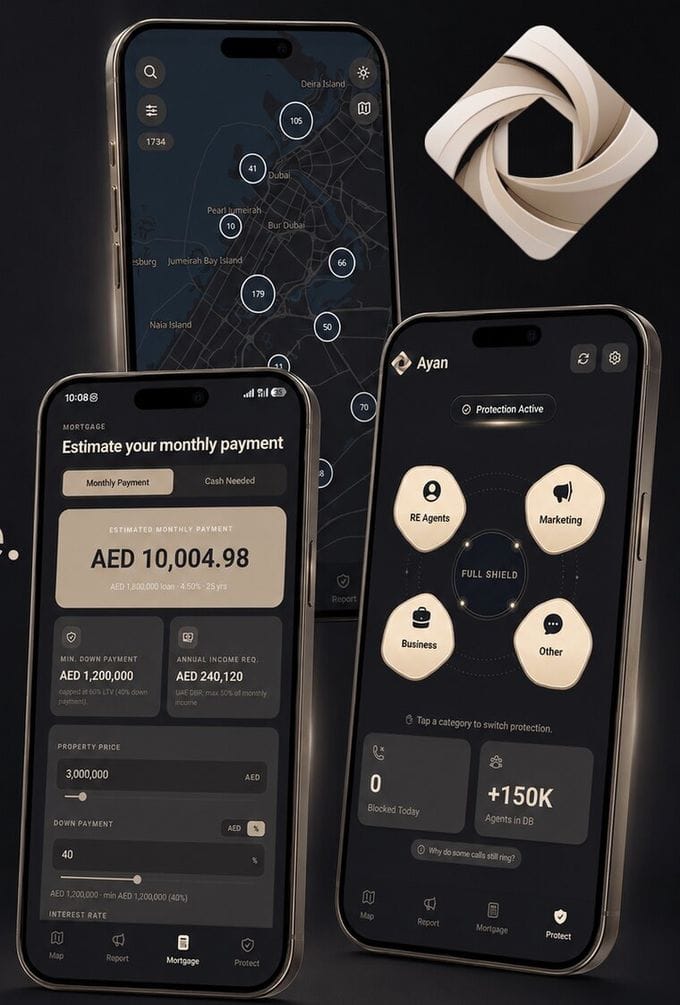
A live off-plan map of 1,700+ UAE projects, a full UAE mortgage calculator and OS-level spam-call protection, all in one app.
Get the AYAN app →Or go straight to the App Store or Google Play. On a computer? Open map.YAZDAN in your browser, no download needed.