
30-SECOND READ — IS THIS FOR YOU?
In one line. Dubai service charges range AED 3-30 per square foot per year, regulated by RERA via the DLD Service Charge Index — JVC sits at AED 8-14/sqft, Dubai Marina at AED 14-28, Downtown at AED 17-40, and the AED/sqft band is the single most under-modelled line item in most buyers’ net-yield math.
Best for. Buyers about to bid on a Dubai apartment or villa, existing owners reviewing the annual budget, and investors underwriting net yield on a specific building.
What you will learn.
• Current AED/sqft service-charge bands by community, with sources
• What service charges actually cover, and why the reserve fund matters more than the headline rate
• How to read the Mollak record and Service Charge Index before bidding
Bottom line. Two apartments with identical gross yields can deliver very different net returns. Service charges are usually the reason. Check the AED/sqft before you check the price.
IN THIS ARTICLE
- Service Charges by Community in 2026
- What Service Charges Actually Cover
- Three Things the AED/sqft Does Not Tell You
- How to Use the Index Before Bidding
Service Charges by Community in 2026
Service charges in Dubai range from AED 3 to AED 30 per square foot per year, regulated by the Real Estate Regulatory Agency (RERA) and published through the Dubai Land Department’s Service Charge Index. The range reflects genuine differences in build quality, amenity load, and management standard — not arbitrary pricing. The published bands, drawn from Driven Properties, FAM Properties, Engel & Völkers, and PropertyWiki community-level data for 2026, give a clean reference set.
Dubai Service Charges by Community (AED per square foot per year, 2026)
The within-community spread is the key insight. Downtown Dubai’s AED 17-40 range is not a typo — two towers on the same street can show a 100%+ difference in AED/sqft. Burj-adjacent prime towers with hospitality-tier service sit at the top of the band; older or amenity-lean towers in the same Downtown postcode sit closer to AED 17. The "Downtown average" is a fiction; the specific tower’s indexed rate is the only number that matters.
Apartment vs villa. Villa service charges are typically lower per square foot than apartments — AED 3-8/sqft is a common villa band — because the amenity overhead is lighter (no lifts, no chiller, no shared corridors). The absolute charge is still meaningful because villas are larger, but the AED/ sqft pressure on net yield is less acute.
What Service Charges Actually Cover
The service charge funds the operating budget of the owners’ association — the entity that manages the building’s common areas, equipment, and shared services. The covered line items, set out by RERA and published transparently for each community, fall into five broad categories.
Common-area maintenance. Lobby, corridors, lift systems, mechanical rooms, building structure. The largest single line item for most apartment towers, driven by lift maintenance and chiller plant servicing in mid- and high-rise buildings.
Security and cleaning. 24-hour security, cleaning of common areas, landscaping (where present), pest control. Scales with building size and amenity load.
Amenities. Swimming pool, gym, sauna, kids’ play areas, concierge, parking systems. This is where the wide AED/sqft variation lives — a basic JVC tower with a small gym and unstaffed lobby runs materially lower than a Marina tower with full amenity programming.
Building insurance. Structural insurance for the building, third-party liability, and common-area coverage. A meaningful line; hard insurance market cycles push this line up across communities.
Reserve fund. The portion of the service charge ring-fenced for major future works — façade refurbishment, lift replacement, chiller plant overhaul, painting cycles. A well-funded reserve fund prevents future "special assessments" (one-off charges levied on owners when major capex arrives without funding); an under-funded reserve fund makes those special assessments inevitable. This line is the one most buyers fail to investigate before purchase.
 Noor Al Nahyan
Three Things the AED/sq.ft Does Not Tell You
The headline AED/sqft is the starting point. Three structural realities sit behind the number that buyers should investigate.
• Reserve fund matters more than headline rate. A building with AED 16/sqft and a fully funded reserve fund is a safer financial position than a building with AED 12/sqft and an under funded reserve. The lower-cost building will trigger special assessments when the major capex cycle hits — usually for façade work or lift replacement — and those special assessments dwarf the AED/sqft difference compared at purchase. Always ask for the reserve fund balance and the next planned major works.
• Year-to-year changes are normal. Service charges rise with utility costs (chiller plant electricity, water), insurance market cycles, contracted service provider rate adjustments, and reserve fund top-ups. A building that has frozen its rate across multiple years is unusual — either it is genuinely well-managed and over-funded, or it is under-funding the reserve. Both warrant a closer look.
• Mollak system tracks approved rates by building. The Mollak system, run by DLD, holds the approved service charge for each registered building and provides the official rate against which any billed amount can be checked. If your annual invoice exceeds the Mollak rate, you have grounds for dispute. Buyers should pull the Mollak record for any target building before bidding.
"Two apartments can show the same gross yield and very different returns. Service charges are usually the reason — check the AED/sqft rate before you check the price." — YAZDAN RESEARCH
Underwriting a Dubai apartment or villa purchase? 30 minutes with our advisory team — we run the service-charge math against your net yield assumption honestly.
How to Use the Index Before Bidding
Three concrete checks before placing any bid on a Dubai apartment or villa.
• Pull the DLD Service Charge Index reading. The DLD Service Charge Index gives the official approved rate for the specific building. The rate published is the legally enforceable maximum the owners’ association can charge for the current year. If the seller’s listing presentation quotes a lower or higher figure than the index, that is a flag worth investigating.
• Read the most recent approved budget. Owners’ association budgets are public to current owners and can usually be obtained via the managing company on request. Read the budget line items — particularly the reserve fund line and the next-three-years capital expenditure schedule. A budget heavy on operational expenditure and light on reserve contribution is the structural setup for future special assessments.
• Model net yield with the correct AED/sqft applied. Take the building’s indexed AED/sqft rate, multiply by the unit’s built-up area, and subtract from gross rent. The resulting net-yield figure is the comparison number worth using against other properties. Two buildings at AED 14/sqft vs AED 22/sqft on a 900-sqft apartment differ by AED 7,200 per year — equivalent to roughly 0.5-0.7 percentage points of net yield on a typical mid-market price point.
 Noor Al Nahyan
Frequently Asked Questions
What is the average service charge in Dubai in 2026?
Service charges range AED 3-30 per square foot per year across Dubai, with mid-market apartments (JVC, Arjan, parts of Business Bay) typically at AED 8-16/sqft, central established communities (Dubai Marina, Downtown lower tier) at AED 14-22/sqft, and prime towers at AED 22-40+/sqft. The within-community spread can be 100%+ between towers.
Who sets the service charge rate?
The owners’ association budgets the rate annually, the appointed management company administers it day-to-day, and RERA reviews it through the Service Charge Index. The Mollak system holds the official approved rate against which any billed amount can be checked.
What does the service charge cover?
Common-area maintenance (lobby, lifts, structure), security and cleaning, amenities (pool, gym, concierge), building insurance, and a reserve fund for major future works. It does not cover anything inside the unit itself.
How much do service charges affect yield?
Materially. On a mid-market apartment, service charges can absorb 1-2 percentage points of gross yield. Always quote yield net of service charges, not gross. The AED/sqft rate is the single most under-modelled line item in most net-yield assumptions.
What is the reserve fund and why does it matter?
A portion of the service charge ring-fenced for major future works (façade refurbishment, lift replacement, chiller overhaul). A well-funded reserve fund signals a healthy building; an under funded one signals future special assessments — one-off charges levied on owners when major capex arrives without funding. Always check before bidding.
SOURCES CITED IN THIS ARTICLE
• Driven Properties — Service Charge Index in Dubai 2026 — DLD Service Fee for Properties
• FAM Properties — Dubai Property Service Charges 2026 | Updated DLD Index
• Engel & Völkers — RERA Service Charge Index in Dubai Properties
• PropertyWiki — Service Charges by Area in Dubai 2026
• Dubai Land Department — Service Charge Index official portal
Want a tailored read for your own position?
YAZDAN Properties helps buyers run net-yield math with the correct service-charge band, and reviews target buildings’ reserve fund health before bidding. Data-led, neutral, no commission talk.
Book a 30-minute advisory call →Or email info@yazdan.ae directly.
This article is editorial analysis. Verify specific building rates via the DLD Service Charge Index and the Mollak system before purchase
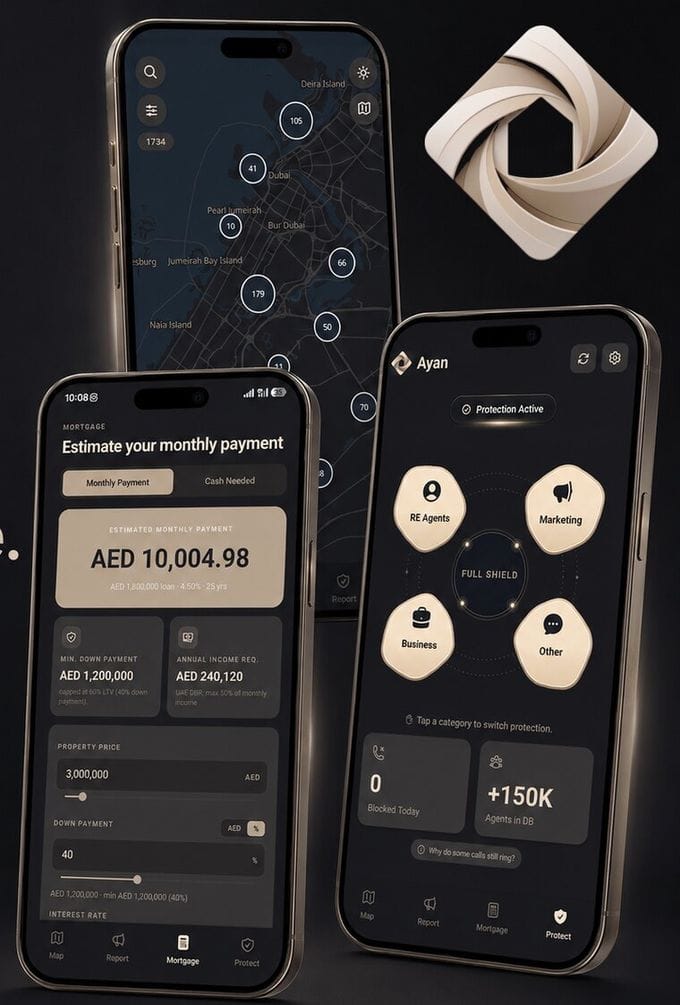
A live off-plan map of 1,700+ UAE projects, a full UAE mortgage calculator and OS-level spam-call protection, all in one app.
Get the AYAN app →Or go straight to the App Store or Google Play. On a computer? Open map.YAZDAN in your browser, no download needed.
YAZDAN Properties reads the DLD numbers for your goal, whether you're buying, selling or investing, and tells you plainly what they mean for you.
Book a 30-minute advisory call → WhatsApp usOr email info@yazdan.ae directly.