Last checked 29 October 2026 against official sources · International investor guides · General information, not tax or legal advice
Saudi citizens can own property anywhere in Dubai, not just in the freehold areas open to other foreigners, because Dubai law gives GCC nationals the same ownership right as Emiratis. Saudi Arabia has no personal income tax, and the UAE doesn't tax individuals' rent or gains, so a Dubai flat held in your own name is generally not taxed on either side. Zakat collected by the state applies to licensed business activity, so the structure you buy through matters more than the tax rate.
Best for. Saudi citizens and Saudi-resident investors comparing a Dubai flat with property in Riyadh, Jeddah or the Eastern Province.
What you'll learn.
- How Dubai compares with the Saudi market right now
- Where Saudi nationals can buy in Dubai, and why it matters when you sell
- When zakat applies to Dubai property
- How to finance and buy from Saudi Arabia
Bottom line. For a Saudi buying in their own name, the main questions are not tax but ownership structure, zakat if you buy through a business, and which buyers you can sell to later.
- The Saudi market you're comparing against
- Dubai now: prices, volumes and yields
- How Saudi Arabia treats your Dubai property
- The Saudi–UAE tax treaty
- Where Saudi nationals can buy in Dubai
- Currency and moving money
- Financing from Saudi Arabia
- Buying from Saudi Arabia, step by step
- Golden Visa
- Ties between Saudi Arabia and the UAE
- Risks to weigh
- Common questions
The Saudi market you're comparing against
Saudi property prices are rising slowly. The General Authority for Statistics (GASTAT) real estate price index was 1.2% higher in Q3 2026 than a year earlier, though it fell 1.2% from the previous quarter. Residential prices rose 2.3% over the year, led by residential land (up 4.9%) and apartments (up 1.7%), while villa prices fell 7.7%. Riyadh was up 4.6% and the Eastern Province down 3.7%.
Rents are still climbing. Actual housing rents in the consumer price index were 3.5% higher in September 2026 than a year earlier, against headline inflation of 1.9%.
Borrowing got dearer in September. The Saudi Central Bank (SAMA) raised its repo rate by 0.25 points to 4.50% on 17 September 2026, after the US Federal Reserve's first increase in more than three years. Saudi banks lent individuals SAR 5.87 billion in new home loans in August 2026, about the same as a year earlier.
Dubai now: prices, volumes and yields
Dubai registered 11,353 property sales worth AED 27.67 billion in September 2026, according to Dubai Land Department records. The median sale was AED 1,321,267, or AED 1,677 per square foot. That is 1.4% lower than a year earlier and 4.3% below the Q1 2026 high of AED 1,770, so prices are off their peak rather than falling sharply. Off-plan sales made up 73% of the month. Full figures are in our Dubai market report, September 2026.
| Area | Gross rental yield | What it suits |
|---|---|---|
| Jumeirah Village Circle | 6.7% | Income first: studios and one-bedroom flats at lower entry prices |
| Dubai Hills Estate | 5.5% | Family homes and prices that rose 5.9% in a year |
| Dubai Marina | 4.6% | Liquid, established, easy to let |
| Downtown Dubai | 4.4% | Prime location, steady prices |
| Business Bay | 3.6% | Prices 20% below a year ago: a possible entry point if rents hold |
| Palm Jumeirah | 3.1% | Capital and lifestyle, not income |
Gross yield = a year of rent against the purchase price, from September 2026 DLD sales and Ejari rent data. Net yield is lower after service charges, letting fees and voids.
You'll see 7% to 9% yields quoted elsewhere. Some single buildings do reach that, but area-wide figures from official data are lower, and the gap to your net return depends on the building's service charge. We show the official numbers for all Dubai areas.
How Saudi Arabia treats your Dubai property
The UAE doesn't tax individuals on income, so there is no UAE income tax on your rent. An individual's rental and sale income from Dubai property held without a trade licence also falls outside UAE Corporate Tax, whatever the amount. There is no annual property tax; owners pay building service charges, and tenants pay a 5% municipality fee on the rent through their utility bill.
Saudi Arabia doesn't run an individual income tax. Salaries are not taxed, and investment income is taxed at the level of a company or permanent establishment, not the person. So rent from a Dubai flat you own personally isn't taxed in Saudi Arabia either.
- Zakat. The Zakat, Tax and Customs Authority (ZATCA) collects zakat from companies and from Saudi-resident individuals who carry on an activity under a licence, under the 2024 zakat collection regulations. A Dubai flat held privately, outside any licensed business, is not part of a zakat assessment by ZATCA. Whether you pay zakat on it as a personal religious duty is a question for your own scholar, not the tax authority.
- Buying through a business. If a Saudi company or licensed sole trader owns the Dubai property, it can enter the zakat base. Under the regulations, property held as a long-term investment and not for sale counts as a fixed asset that can be deducted from the base, while property bought to resell doesn't qualify for that deduction. An off-plan unit bought to flip can therefore be treated very differently from one held for rent.
- Reporting. Saudi individuals don't file a personal income tax return, so there's no Saudi form for declaring foreign property. Saudi Arabia does take part in the OECD Common Reporting Standard through ZATCA, so a UAE bank account held by a Saudi tax resident can be reported back to Saudi Arabia.
- Expats living in Saudi Arabia. If you live in the Kingdom but hold another passport, Saudi Arabia won't tax your Dubai rent, but your home country might. US citizens, for example, are taxed on worldwide income wherever they live.
The Saudi–UAE tax treaty
Saudi Arabia and the UAE signed an agreement to avoid double taxation on income and capital in Jeddah in May 2018. It came into force in April 2019. It covers taxes on income and capital and tax cooperation between the two authorities.
For an individual Saudi investor it changes little in practice, because neither country taxes your personal rent or gain from a Dubai flat. It matters more for companies, for example a Saudi company with a permanent business presence in the UAE, which may also be in scope of UAE Corporate Tax.
Where Saudi nationals can buy in Dubai
Dubai Law No. 7 of 2006 on real property registration limits the right to own property anywhere in the emirate to UAE nationals, GCC nationals, companies wholly owned by them, and public joint stock companies. Other foreigners can only own freehold, or hold a lease or usufruct of up to 99 years, in areas the Ruler has designated.
- What this means for you. As a Saudi citizen you can buy freehold in the designated areas, like any foreigner, and also outside them, in older neighbourhoods that are closed to most international buyers.
- Companies. A UAE onshore company qualifies only if UAE or GCC nationals own all of it. One non-GCC shareholder takes it outside the rule, as Al Tamimi & Co.'s guide to the law explains.
- Resale. A property outside the designated areas can only be sold to buyers who share that right: UAE and GCC nationals and qualifying companies. That smaller pool of buyers can mean a longer sale.
- Saudi residents who aren't citizens. The GCC right follows nationality, not residence. An Indian or Egyptian national living in Riyadh buys under the same rules as any other foreigner.
Currency and moving money
Both currencies are tied to the US dollar, so the exchange rate barely moves. One Saudi riyal bought AED 0.978 at the end of August 2026, according to the UAE Central Bank. For a Saudi investor, a Dubai property carries almost no currency risk, but UAE interest rates follow the Federal Reserve, just as Saudi rates do.
- Travellers entering or leaving Saudi Arabia must declare cash, cheques, gold or jewellery worth SAR 60,000 or more to ZATCA.
- Most buyers pay by bank transfer to the developer's escrow account (off-plan) or by manager's cheque at the transfer (resale).
Financing from Saudi Arabia
UAE banks follow Central Bank caps for expatriate buyers: up to 80% of the price for a first home under AED 5 million, 70% above that, 60% for a second or investment property and 50% for any off-plan purchase. The rules don't set a separate limit for non-residents. Each bank decides, and non-residents usually see lower limits, more paperwork and minimum balance requirements.
SAMA's rules let Saudi banks lend citizens up to 90% of the value of a first home, a limit set in January 2018, but that applies to homes in the Kingdom. Saudi banks don't usually take a Dubai property as security, so most Saudi buyers pay cash, borrow from a UAE bank, or use an off-plan payment plan spread over construction. Treat this as general information and compare offers from UAE banks directly.
More in our guide to UAE mortgage rules and LTV limits.
Buying from Saudi Arabia, step by step
- Choose the area and building using official yields and service charges, not brochure figures. If the property is outside the freehold areas, confirm your right to own it first.
- Sign the agreement: an Oqood registration for off-plan, or a RERA Form F (memorandum of understanding) and 10% deposit for resale.
- Pay into escrow (off-plan) or arrange the manager's cheques (resale).
- Complete the transfer at a DLD trustee office, in person or through a power of attorney. With a short flight and entry on your national ID card, many Saudi buyers simply attend in person.
The UAE is not a party to the Apostille Convention, so an apostille on its own is not enough. A power of attorney or other document signed abroad needs the full legalisation chain before the Dubai Land Department will accept it:
- Sign the power of attorney before a notary in Saudi Arabia (a Ministry of Justice notary or licensed notary).
- Have it authenticated by the Saudi Ministry of Foreign Affairs. Saudi Arabia joined the Apostille Convention in 2022, but the UAE hasn't, so the apostille alone won't do.
- Have it attested by the UAE Embassy in Riyadh or the UAE Consulate in Jeddah.
- Have it attested by the UAE Ministry of Foreign Affairs in the UAE. A Saudi document is usually already in Arabic, so it may not need translating.
Under DLD Circular 29/R/2025, as summarised by law firms, a power of attorney signed abroad must name the specific transaction, be issued within the last two years, be presented as the original, and come with a legal Arabic translation. Most buyers avoid the paperwork by signing in Dubai on a visit, or by signing the sale agreement electronically and only using a power of attorney for the transfer. See our Power of attorney for Dubai property.
Costs on a resale purchase:
| Cost | Amount | Who pays |
|---|---|---|
| DLD transfer fee | 4% of the price | Buyer, in practice |
| Registration (trustee) fee | AED 2,100 under AED 500,000; AED 4,200 above | Buyer |
| Mortgage registration | 0.25% of the loan | Buyer, if borrowing |
| Agency commission | Agreed in the RERA brokerage contract; commonly 2% plus VAT | Buyer |
| Service charges | Set per building each year by RERA | Owner |
Sources: Dubai Land Department fee pages; agency commission is market practice, not a fixed fee. More detail in our guide to Dubai property fees and taxes.
Golden Visa
Property worth at least AED 2 million can qualify the owner for a 10-year UAE Golden Visa. It gives the right to live in the UAE; it doesn't make you tax-resident anywhere on its own, and it doesn't change your home country's tax rules. The details on mortgaged, jointly owned and off-plan property are in our Golden Visa through property: the legal requirements.
Saudi citizens don't need it. GCC citizens can enter, live and work in the UAE without a visa, permit or sponsor, using a GCC passport or national ID card. The Golden Visa is more relevant to non-Saudi investors living in Saudi Arabia.
Ties between Saudi Arabia and the UAE
- The UAE took 10% of Saudi Arabia's merchandise exports in 2025, second only to China, and was its third-largest source of imports, according to the UAE Ministry of Foreign Affairs.
- In April 2026 alone, Saudi exports to the UAE were SAR 10.8 billion and imports from it SAR 6.0 billion. Saudi Arabia was the largest destination for UAE re-exports in Q1 2026, taking 20.5% of the total.
- UAE direct investment in Saudi Arabia stood at SAR 161.3 billion at the end of 2024, and the two countries signed a financial cooperation agreement in February 2025.
- GCC citizens enter the UAE with a passport or national ID card and need no visa.
Risks to weigh
- Resale outside freehold areas. Only UAE and GCC buyers can purchase there, so selling can take longer.
- Zakat through a business. Holding the property in a licensed Saudi business can bring it into the zakat base, especially if it's held for resale.
- Rates. UAE and Saudi rates both follow the Fed, which raised rates in September 2026. Model any UAE mortgage at higher rates.
- Net yield. Service charges, letting fees and empty months cut the gross yields shown above, and 73% of September's sales were off-plan, where you wait years for rent.
Common questions
Can Saudi citizens buy property anywhere in Dubai?
Yes. Dubai Law No. 7 of 2006 gives GCC nationals, including Saudis, the right to own property throughout the emirate, while other foreigners are limited to designated freehold areas. Confirm the position for the specific property with the Dubai Land Department before you sign.
Do I pay tax in Saudi Arabia on Dubai rental income?
Not as an individual. Saudi Arabia has no personal income tax and the UAE doesn't tax individuals' rent. Zakat collected by ZATCA applies to companies and licensed business activity, so it can apply if a business owns the property.
Is there a tax treaty between Saudi Arabia and the UAE?
Yes. It was signed in May 2018 and came into force in April 2019, covering income and capital. For an individual it changes little, since neither country taxes personal rent from a Dubai flat.
Do Saudis need a Golden Visa to own property in Dubai?
No. GCC citizens can live and work in the UAE without a visa or sponsor. Property ownership doesn't depend on any visa.
- GASTAT: Real Estate Price Index, Q3 2026
- GASTAT: Consumer Price Index, September 2026
- Asharq Al-Awsat: SAMA raises repo rate to 4.50% after Fed increase (17 September 2026)
- Argaam: New residential mortgages to individuals, August 2026 (SAMA data)
- SAMA Rulebook: Raising the maximum real estate finance for citizens' first home (January 2018)
- ZATCA: Implementing Regulations for the Collection of Zakat (2024)
- PwC Worldwide Tax Summaries: Saudi Arabia, taxes on personal income
- ZATCA: CRS Guidance Notes, Kingdom of Saudi Arabia
- PwC: KSA signs MCAA addendum for the OECD Common Reporting Standard (August 2026)
- Gulf News: UAE–Saudi double taxation agreement comes into effect (April 2019)
- Dubai Legislation Portal: Law No. 7 of 2006 Concerning Real Property Registration in the Emirate of Dubai
- Al Tamimi & Co.: Who can own real estate in Dubai and where?
- Khaleej Times: Travellers must declare cash and valuables of SAR 60,000 or more (ZATCA rule)
- UAE Government portal (u.ae): Visa-free entry for GCC citizens
- UAE Ministry of Foreign Affairs: Economic cooperation with Saudi Arabia
- Central Bank of the UAE: Quarterly Economic Review, September 2026
- Central Bank of the UAE: Exchange rates, August 2026
- Yazdan Properties: Dubai Market Report, September 2026 (Dubai Land Department records)
- UAE Government portal (u.ae): Taxation
- UAE Federal Tax Authority: Real Estate Investment for Natural Persons, Corporate Tax guide (October 2024)
- Dubai Land Department: Frequently asked questions
- Dubai Land Department: Registering the sale of a mortgaged property (fees)
- Central Bank of the UAE Rulebook: Mortgage Loans Regulations, Article 3 (as amended April 2020)
- Central Bank of the UAE: How the monetary system works
- HCCH: Apostille Convention status table
- UAE Ministry of Foreign Affairs: Attestation services
- BSA Law: Dubai's new standards for powers of attorney in property deals (DLD Circular 29/R/2025, August 2025)
Investing in Dubai from Saudi Arabia?
Yazdan Properties is a RERA-registered brokerage in Dubai. We'll check what you can own, run a building's real numbers and arrange the transfer around your visit.
Book a 30-minute advisory call →Prefer WhatsApp? Get this guide as a PDF on WhatsApp
General information, not tax, legal or financial advice. Tax rules depend on your circumstances and change often; speak to a qualified adviser in your home country before you buy. Market figures are from Dubai Land Department records unless stated.
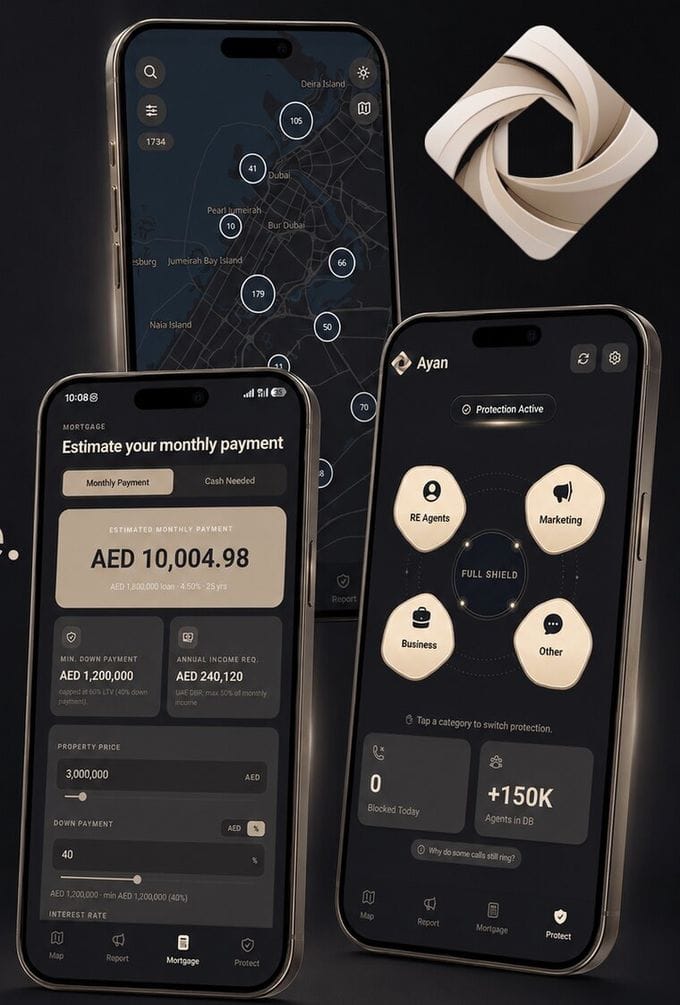
A live off-plan map of 1,700+ UAE projects, a full UAE mortgage calculator and OS-level spam-call protection, all in one app.
Get the AYAN app →Or go straight to the App Store or Google Play. On a computer? Open map.YAZDAN in your browser, no download needed.